
PAGE_HEADER
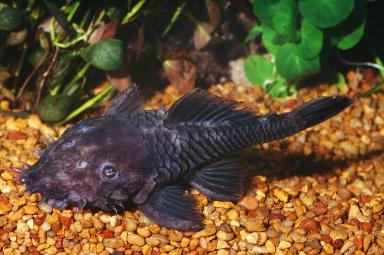
 Dorsal view
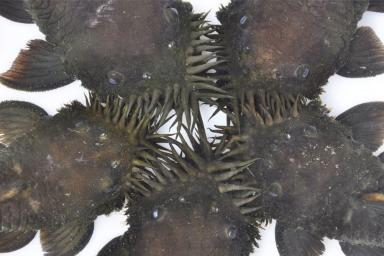
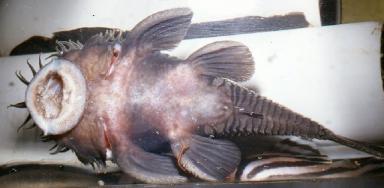 Ventral view
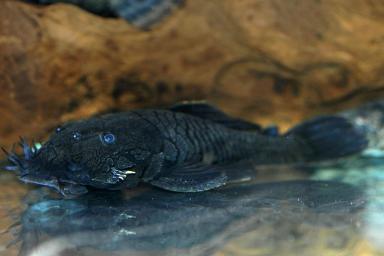
 Close-up of eye
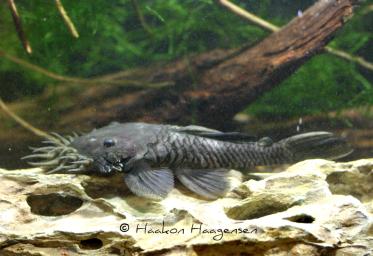

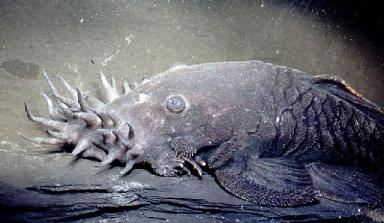
 Male
 Dorsal view
 Pair - female on right


 Eggs hatching
 Four day old fry
 Nineteen day old fry
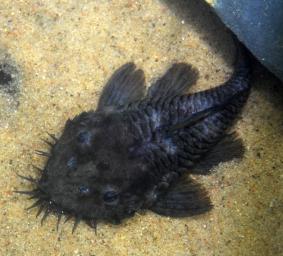
 Month old juvenile
 Close-up of interopercular spines


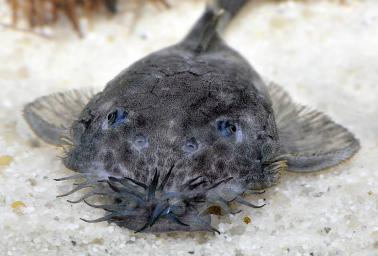 Head-on view
 Cachoeira Grande do Iriri, 03°50'35.5"S, 052°44'08.3"W
| ⇓ Zebra Pleco (Hypancistrus zebra) Data Sheet | |
|---|---|
| Scientific Name | Ancistrus ranunculus Muller, Rapp Py-Daniel & Zuanon, 1994 |
| Common Names | L034, Medusa Pleco Bredhovedet Antenne-sugemalle (Danish, Denmark), Kaulquappenwels/bristle Bushmouth (German, Germany) |
| Type Locality | Rio Xingú, furo do Tucum Seco, near Arroz Cru, Pará State, Brazil. |
| Synonym(s) | |
| Pronunciation | an SISS truss - rah nun kew luss |
| Etymology | The name Ancistrus is derived from the Greek word agkistron, meaning hook, in reference to the interopercular odontodes that are hooked. This specific epithet literally means small frog or tadpole (ranunculus=diminutive frog or tadpole) and refers to its unusually wide head. |
| ⇓ Species Information | |
| Size | 129mm or 5.1" SL. Find near, nearer or same sized spp. |
| Identification | Mature males and sometimes females have soft tentacles (bushy fleshy growths) on the snout - this is unique to the genus Ancistrus. Although all black, this is an easily identified species of Ancistrus due to its extreme head-width. |
| Sexing | Males develop soft tentacles on the head and while sometimes females also do, it is never to the grand extent of those found on that of the conspecific male. Both sexes exhibit the Ancistrus trademark head-tentacles but they are much more prominent in sexually mature males. |
| ⇓ Habitat Information | |
| Distribution | South America: Xingu and Tocantins River basins in Brazil. Amazon, Lower Amazon, Tocantins (click on these areas to find other species found there) Amazon, Lower Amazon, Xingu (click on these areas to find other species found there) Amazon, Lower Amazon, Xingu Imported (click on these areas to find other species found there) Login to view the map. |
| IUCN Red List Category | Near Threatened , a distribution map is available on the IUCN species page. Last assessed 2018. |
| Temperature | 25.0-28.0°C or 77-82.4°F (Show species within this range) |
| ⇓ Husbandry Information | |
| Feeding | Although still omnivorous, tends to be more of a carnivore than your average Ancistrus. User data. |
| Furniture | Natural habitat is stony streams. Prefers to hide between cracks in the rock-base or under flat stones on the bottom. |
| Compatibility | A good complement to most aquariums, they are not aggressive to other species. Males may fight over territory if kept in too small a tank. |
| Suggested Tankmates | All community fish, small to medium sized cichlids. |
| Breeding | Typical Ancistrus breeding behaviour. Males stay in caves and guard the brood. Females lay about 8 to 12 eggs. Eggs hatch after 5-7 days. After about 10 days the yolk sac is totally absorbed and the young start to eat. Fry are not problematic to raise. Once conditioned for spawning they spawn as often as common Ancistrus. Further information in breeding reports and Shane's World articles. |
| Breeding Reports | There is no breeding report. |
| ⇓ Further Information | |
| Literature & References | Original Description: <b> Muller, S., L. H. Rapp Py-Daniel and J. Zuanon</b> 1994 (Dec.) |
| Wishlists | There is no wish to keep this species. |
| Spotters | There is no record of this fish being seen. |
| ⇓ More Resources | |
| Forum BBCode | |
| Find CLOG | 56 mentions on the forum, starting 13th Aug 04 |
 | Look up A. ranunculus on PlanetCatfish.com |
 | Look up A. ranunculus on Fishbase |
 | Look up A. ranunculus on Encyclopedia of Life |
 | Look up A. ranunculus on Global Biodiversity Information Facility |
 | LFS label creator ARN ref:1.4.4.190 |
| Last Update | Wed Jan 01, 2025 8:06 pm (Species record created: Wed Apr 25, 2001 7:00 am) |
