
PAGE_HEADER

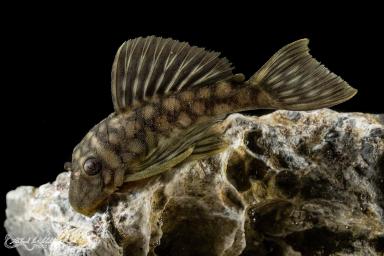
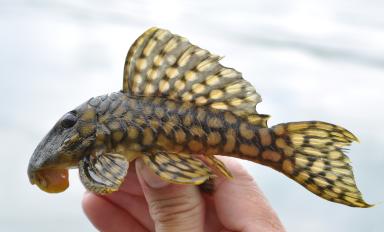
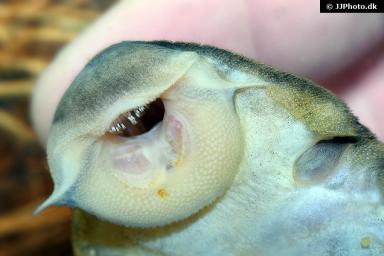 Close-up of mouth
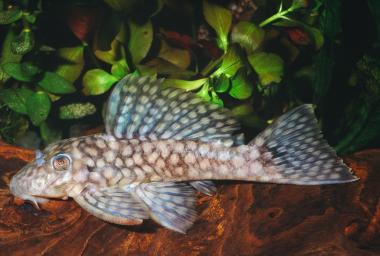

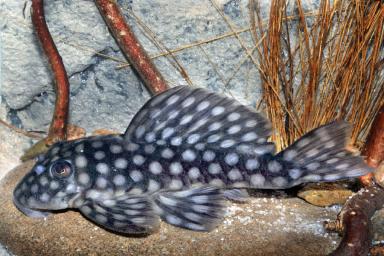 Female
 Pair, female above
 Ventral view of female

 Female
 Male
 Ventral view of male

 Cachoeira Grande do Iriri, 03°50'35.5"S, 052°44'08.3"W
 Ventral view
 Close-up of head
 Close-up of dorsal fin
 Close-up of mouth
| ⇓ Zebra Pleco (Hypancistrus zebra) Data Sheet | |
|---|---|
| Scientific Name | Spectracanthicus zuanoni Chamon & Rapp Py-Daniel, 2014 |
| Common Names | L020, Acari Bola Branca Storplettet Sugemalle (Danish, Denmark) |
| Type Locality | Ilha do Sr. Izaltino, rio Xingu, Altamira, Pará, Brazil, 3°16'21"S, 52°12'07"W. |
| Synonym(s) | |
| Etymology | Genus: Latin, spectrum = look, apparition + Greek, akantha = thorn. There are 2 other speciesDoras zuanoni Sternarchogiton zuanoni with this name. |
| ⇓ Species Information | |
| Size | 129mm or 5.1" SL. Find near, nearer or same sized spp. |
| Identification | Spectracanthicus can be separated from all other loricariids except some Baryancistrus, Parancistrus and an undescribed Hemiancistrus by the presence of the dorsal-fin membrane contacting the adipose-fin spine. It can be separated from Baryancistrus and the Hemiancistrus by having fewer teeth (less than 25 vs. greater than 25) and from Parancistrus by having restricted gill openings. A key to the genus can be found here. L019 and L020 are problematic species in terms of identification. The original DATZ article shows an underwater picture (the fish is actually trying to hide in a shoe!!!) where you only could see the coloration of the fish. However, this coloration belongs to two different species found at the same place in the Xingú, a Baryancistrus species (L019) and an Spectracanthicus species. We don't know which genus the first L020 belonged to. To clarify this for the future, L019 is the Baryancistrus sp. and L020 the Oligancistrus sp. |
| ⇓ Habitat Information | |
| Distribution | South America: Brazil: Rio Xingú at Altamira Amazon, Lower Amazon, Xingu (click on these areas to find other species found there) Login to view the map. |
| IUCN Red List Category | Not Evaluated |
| Temperature | 25.0-30.0°C or 77-86°F (Show species within this range) |
| ⇓ Husbandry Information | |
| Feeding | This species grazes on rocks, eating algae and other organisms in the periphyton. It typically feeds at night. User data. |
| Furniture | In nature, this species is a moderate reophilic species that is found in rock-bottom areas subjected to backwater and strong currents. Specimens were found individually or in groups of three, under shelter boulders (adults) and spaces beneath rocks (juveniles), up to 2m deep. |
| Suggested Tankmates | In nature, juvenile S. zuanoni are collected with Ancistrus sp., A. ranunculus, Baryancistrus xanthellus, Spectracanthicus punctatissimus, Hopliancistrus tricornis, Parancistrus nudiventris, Peckoltia vittata, and Pseudancistrus aff. barbatus. |
| Breeding | Has been bred in the aquarium. |
| Breeding Reports | There is no breeding report. |
| ⇓ Further Information | |
| Reference | Neotropical Ichthyology v. 12 (no. 1), pp 19, Figs. 14-15. |
| Wishlists | There is no wish to keep this species. |
| Spotters | There is no record of this fish being seen. |
| ⇓ More Resources | |
| Forum BBCode | |
| Find CLOG | 17 mentions on the forum, starting 14th Apr 13 |
 | Look up S. zuanoni on PlanetCatfish.com |
 | Look up S. zuanoni on Fishbase |
 | Look up S. zuanoni on Encyclopedia of Life |
 | Look up S. zuanoni on Global Biodiversity Information Facility |
 | LFS label creator ARN ref:1.4.88.187 |
| Last Update | Thu Jan 02, 2025 9:37 am (Species record created: Sat May 05, 2001 7:00 am) |
