
PAGE_HEADER
 L066
 L066
 L066 - Male
 L066 - Close-up of head
 L066 - close-up of dorsal fin
 L066
 Feeding on prawns
 L066 - Close-up of head of female
 L066 - Close-up of head of male
 L066 - Male with brood
 L066 - Male guarding eggs in pipe cave
 L066
 L066
 L066 - Juveniles in spawning cave
 L066
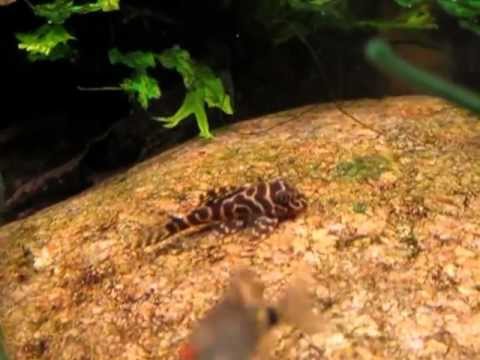 L066 - Video
 L066
 L066 - Young juvenile
 L066 - Fry with yolk sac
 L066 - Three week old L260 and four week old L066 (top)
 Eggs of L066(right) and L046
 L066
 L066
 L066
 L066 - Three month old juvenile
 L066 - Female
 L066
 L066 - Two day old fry
 L066
 L066 - Ventral view
 L066 - Dorsal view
 L066
 L066 - Close-up of head, male
 L066 - Juvenile
 L066 - Pair spawning
 L066 - Close-up of caudal fin
 L066 - Close-up of caudal fin
 L333
 L333
 L333
 L333
 L333
 L333
 L333
 L333
 L333 - Leucistic individual
 L333
 L333
 L333 - Juveniles
 L333
 L333 - Ventral view
 L333 - Male
 L333
 L333 - Eggs in cave with dad
 L333 - Spawning
 L333 - Five week old youngsters
 L333 - Fry in cave with dad
 L333 - Albino
 L333 - Close-up of head
 L333 - Close-up of pectoral fin
 L333 - Close-up of dorsal fin
 L333 - Close-up of caudal fin
 L236
 L236
 L236
 L236
 L236
 L236
 L236
 L236
 L236
 L236 - Dorsal view
 L236
 L236
 L236
 L236
 L236 - F1 - Left hand side of individual `fish A`
 L236 - F1 - Right hand side of individual `fish A`
 L236 - Female
 L236 - Female
 L236 - Male
 L236
 L236 - Nursery tank
 L236 - Snub nosed
 L236 - Juveniles
 L236 - Mixed rearing tank
 L236 - Juveniles
 L236 - Juveniles
 L236 - Fry
 L236 - Juvenile
 L236 - Juvenile
 L236 - Sub adult
 L236 - 2 cm juvenile
 L236 - Ventral view of 2 cm juvenile
 L236 - Ventral view of head
 L236
 L287
 L287 - Female (above) and F1
 L287 - F1
 L287 - F1
 L287 - F1
 L287 - F1
 L287 - F1
 L287
| ⇓ Zebra Pleco (Hypancistrus zebra) Data Sheet | |
|---|---|
| Scientific Name | Hypancistrus seideli Sousa, Sousa, Oliveira, Sabaj Pérez, Zuanon & Rapp Py-Daniel, 2025 |
| Common Names | L066, King Tiger Pleco L236, L287, L333, Acari Pão (Portuguese, Brazil), Collar Zebra Pleco, Cracked Zebra Pleco, Finbroderet Sugemalle (Danish, Denmark), Halsbånds Zebrasugemalle (Danish, Denmark), Krakaleret Zebrasugemalle (Danish, Denmark), Labyrint-zebrasugemalle (Danish, Denmark), Maze Zebra Pleco, Network Pleco, Scribbled Pleco |
| Type Locality | Vitória do Xingu, Itaubinha, pedral, Pará State, Brazil, 02°53'21"S, 51°56'26"W. |
| Synonym(s) | Hypancistrus sp(l287) |
| Pronunciation | hype an siss truss |
| Etymology | A contraction of the Greek hypo (meaning less than) and ancistrus, an allusion to the reduced number of teeth (particularly in the lower jaw) found in this genus. Named for the accomplished German aquarist, Ingo Seidel - an all-round good guy. |
| Variants | L066, L333, L236, L287, L399, L400, L470 |
| ⇓ Species Information | |
| Size | 150mm or 5.9" SL. Find near, nearer or same sized spp. |
| Identification | A distinctive species that was historically separated by patterning giving rise to several l-numbers for this species. L066, L287, L236, L333, L399, L400 and L401 are all within the scope of this variable species which is only found in the Rio Xingu. Each l-number has typical characteristics, but they are indicative and broad - they are detailed below. This is more a case of "it's a bit more like this than that" rather than absolute differentiation. In all of these l-numbers, youngsters are quite different from the adults. All will interbreed. L066 has a paler base colouration than L333 where L333 can be pale or yellow/light brown base colouration. L066 has even/straight lines in the fins, other similar fish do not. L236 is line bred and has much paler colour than dark. It can also be yellow or white. L401 has narrower dark areas, but still many broken lines. If kept in good water conditions, this fish displays a very dark brown to black body with white lines.L066 looks a little more elongate and L333 is also stubbier from head to tail than most other L-numbers in this species. |
| Sexing | Mature males have thicker first pectoral ray, more pronounced odontodes on the first pectoral fin ray and odontodes on the cheeks and/or rear of the body, and typically a wider head. Mature females are wider around the middle of the body, and much less noticeable body and fin odontodes. Adult males develop teeth-like odontodes around the head and the pectoral fins. Viewed from above the female looks much more massive than the male. Easiest way of sexing even half-grown ones is to provide enough caves. The fish entering and staying in the holes are only the males. |
| General Remarks | L236 was introduced June 1997, p 349 in DATZ magazine as being from the Rio Iriri, a tributary of the Rio Xingu Para State, Brazil however it is more likely that the handful of original specimens came from the lower main river channel. Unfortunately, there is much confusion surrounding this L287. DATZ issued it L287 in December 2000. Then in Feb. 2001 DATZ issued L287 to a Hypancistrus-type fish from the Rio Curua-Una, Para, Brazil. The second fish issued L287 was later given the L Number L307. DATZ listed L287 as coming from the Rio do Para, Brazil and reaching 10cm. Das Aquarium (June 2002) issued the same fish the designation LDA069, stated that it came from "Venezuela," and grew to 7cm. The 2nd Ed. Aqualog book (2004) then published that the fish was in fact not from the Rio do Para, but a tributary of the Rio Xingu. A total mess. |
| ⇓ Habitat Information | |
| Distribution | Rio Xingu, Brazil Amazon, Lower Amazon, Xingu, Lower Xingu (click on these areas to find other species found there) Amazon, Lower Amazon, Tocantins (click on these areas to find other species found there) Amazon, Lower Amazon, Xingu (click on these areas to find other species found there) Amazon, Lower Amazon, Xingu (click on these areas to find other species found there) Amazon, Lower Amazon, Xingu (click on these areas to find other species found there) Login to view the map. |
| IUCN Red List Category | Not Evaluated |
| pH | 5.8 - 7.6 |
| Temperature | 24.0-31.0°C or 75.2-87.8°F (Show species within this range) |
| Other Parameters | This species prefers good current and high oxygen levels. |
| ⇓ Husbandry Information | |
| Feeding | Omnivorous. They still prefer meaty food such as bloodworms, Gammarus and brine shrimp. Commercially prepared food such as sinking catfish food, Spirulina tabs are also avidly eaten. User data. |
| Furniture | Sand substrate and many caves or holes for the males to hide. Wood or plants are welcome but not necessary, the latter will sometimes be grazed upon to the long-term detriment of the plant. |
| Compatibility | Very good tankmate for any fish living at the top of the water column. More demanding of the aquarist if attempting to keep together with Corydoras or other ground-living fish. Lightly territorial to conspecifics. |
| Suggested Tankmates | Small tetras and other similar small fish. Also Corydoras. Care has to be taken to ensure that they get enough food, as they can be a bit shy and slow to grab food when younger. Established fishes are robust and can happily co-exist with more boisterous tankmates. |
| Breeding | Straightforward. The male keeps about 50-80 eggs in his hole. The fry leave the parental home at about 14 days and can easily be feed with tablets and frozen foods. Use a neutral pH and very soft water, temperature should be around 30 Celsius. |
| Breeding Reports | There is no breeding report. |
| ⇓ Further Information | |
| Reference | Neotropical Ichthyology v. 23 (no. 1): e240080, pp 11, Figs. 5-7. |
| Wishlists | There is no wish to keep this species. |
| Spotters | There is no record of this fish being seen. |
| ⇓ More Resources | |
| Forum BBCode | |
| Find CLOG | 68 mentions on the forum, starting 14th Nov 05 |
 | Look up H. seideli on PlanetCatfish.com |
 | Look up H. seideli on Fishbase |
 | Look up H. seideli on Encyclopedia of Life |
 | Look up H. seideli on Global Biodiversity Information Facility |
 | LFS label creator ARN ref:1.4.7.174 |
| Last Update | Wed Sep 16, 2026 6:53 pm (Species record created: Sat May 05, 2001 7:00 am) |
