
PAGE_HEADER
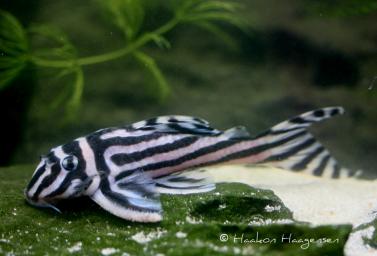
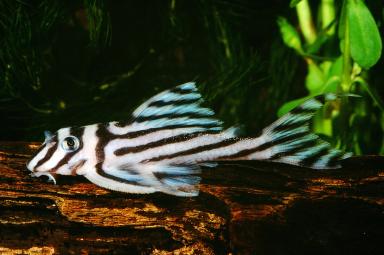
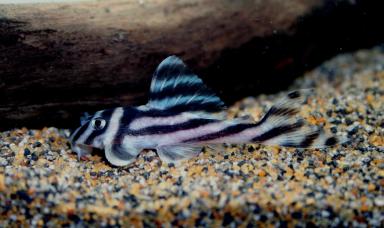
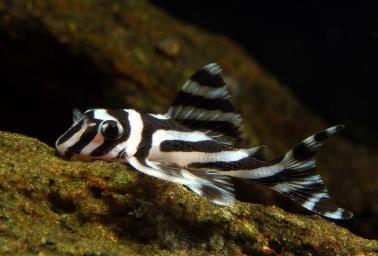 Juvenile
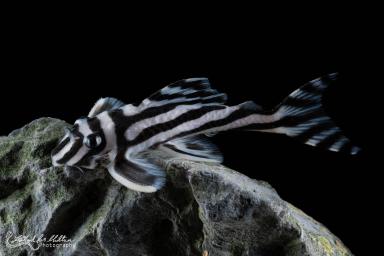
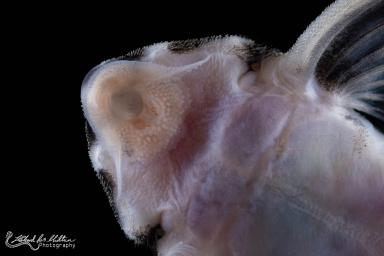

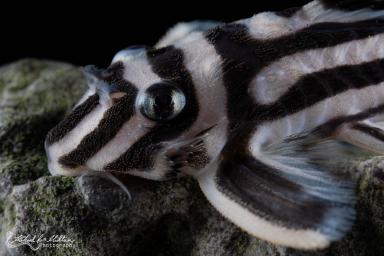 Close-up of head
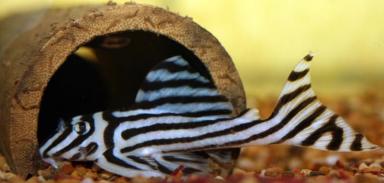
 Pair in spawning cave
 Spawning tank set-up
 Spawning tank set-up
 Egg clutch at far end of breeding cave
 Captive bred infants
 Habitat: Rio Xingu, Brazil


 Atypical patterning


 Group
 Male guarding egg clutch (right)
 Eggs hatching
 Juveniles
 Ventral view
 Three day old fry
 Eight day old fry
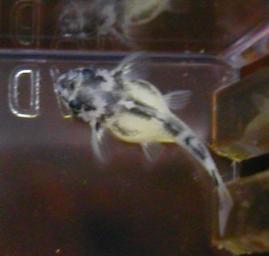 Dorsal view - nine day old fry
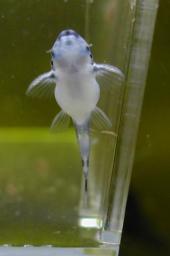 Ventral view - ten day old fry
 Dorsal view - eleven day old fry
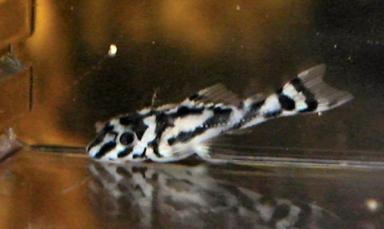 twelve day old fry
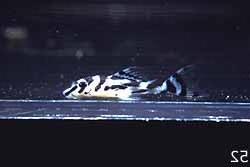 Fry
 One hour old eggs
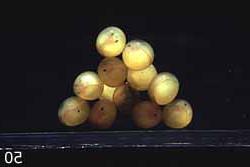 Six day old eggs
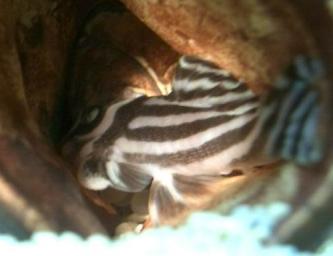 Male guarding eggs
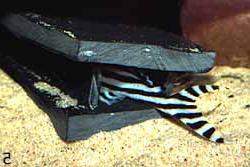


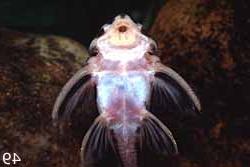
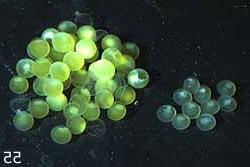 Eggs of L066(right) and L046
 Ventral view
 Father and son
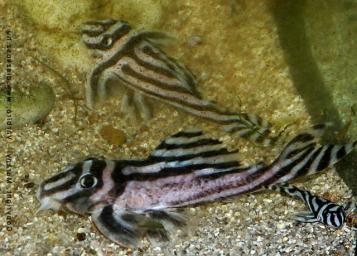 Male scarred by fighting
 Video
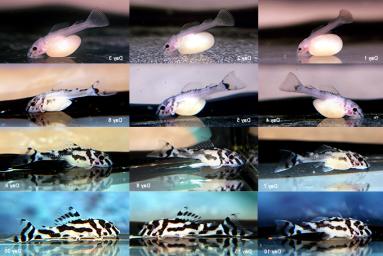 Fry development
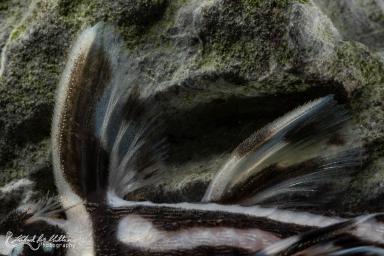 Close-up of pectoral fin
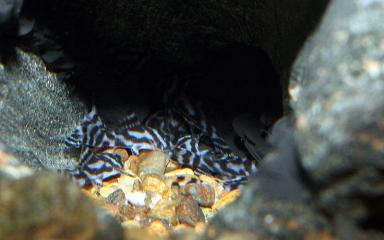 Twenty five day old
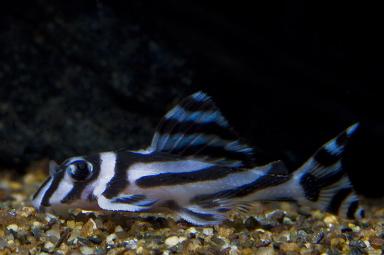
 Ventral view

 Pair - female top
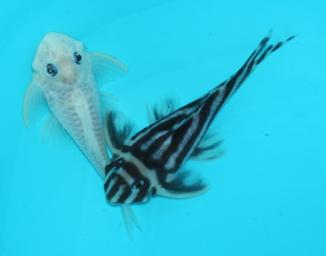 Leucistic and normal coloured
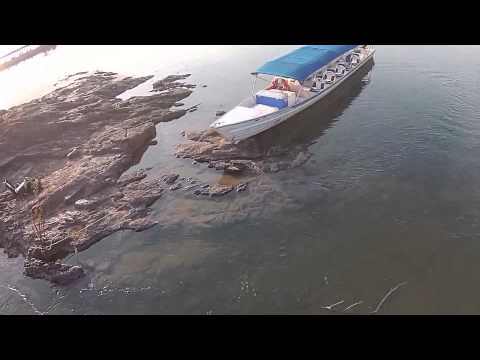 Video: Air Xingu
 Close-up of caudal fin
| ⇓ Zebra Pleco (Hypancistrus zebra) Data Sheet | |
|---|---|
| Scientific Name | Hypancistrus zebra Isbrücker & Nijssen, 1991 |
| Common Names | L046, Zebra Pleco L098, Blåfinnet Zebrasugemalle (Danish, Denmark), Imperial Pleco, Zebra-sugemalle (Danish, Denmark), Zebrawels (German, Germany) |
| Type Locality | About 1 hr. upstream of Altamira by speedboat, anastomoses of Rio Xingú, Pará State, Brazil. |
| Synonym(s) | |
| Pronunciation | hype an siss truss - zee BRA |
| Etymology | A contraction of the Greek hypo (meaning less than) and ancistrus, an allusion to the reduced number of teeth (particularly in the lower jaw) found in this genus. zebra from the African black and white striped equine. There are 3 other speciesHypsopanchax zebra Omobranchus zebra Trematocara zebra with this name. |
| ⇓ Species Information | |
| Size | 75mm or 3" SL. Find near, nearer or same sized spp. |
| Identification | It is hard to misidentify this, the most high-profile aquarium catfish of our time, its black and white pattern is unique. Known by the l-number L046 (the common form) and L098 which is an uncommonly found wavy or broken line colour variation. |
| Sexing | Mature males have thicker first pectoral ray, more pronounced odontodes on the first pectoral fin ray and odontodes on the cheeks and/or rear of the body, and typically a wider head. Mature females are wider around the middle of the body, and much less noticeable body and fin odontodes. The first pectoral fin ray of the male is somewhat thicker than that of the female. Males in breeding condition further develop their spine-like ''odontodes'' on this ray. The male has a slightly broader head than the female, best observed from above. |
| General Remarks | Discovered in late 1987 by Yoshio Ogawa. A fish exporter based in Belem at the time, he was misdirected to collect fishes in the Xingu by another fish exporter because it was a blank spot on the map and out of the way. Ogawa quickly found many of the plecos that formed the backbone of what would drive the l-number boom. In those days, H. zebra could be collected by sitting on a rock and searching for them in crevices - no diving required. By the end of the decade, the secret of its location was no more and it was exported by many companies driving a new fish export economy in nearby Altamira. Isbrücker & Nijssen's 1991 description states that the species was found "About 1 hr. upstream of Altamira by speedboat, anastomoses of Rio Xingu, Pará, Brazil.". However, in keeping with much about this species early recorded history, this is incorrect. Isbrücker & Nijssen did not collect in the Xingu. The source of this information was influenced by the desire to keep the location, which had been commercially valuable information, obfuscated for as long as possible. The real locality is closer to one hour downstream by speedboat from Altamira. |
| ⇓ Habitat Information | |
| Distribution | South America: Xingu River basin, Brazil. Amazon, Lower Amazon, Xingu, Lower Xingu (click on these areas to find other species found there) Amazon, Lower Amazon, Xingu, Middle Xingu (click on these areas to find other species found there) Login to view the map. |
| IUCN Red List Category | Critically Endangered , a distribution map is available on the IUCN species page. Last assessed 2018. |
| pH | 6.0 - 7.5 |
| Temperature | 26.0-30.0°C or 78.8-86°F (Show species within this range) |
| Other Parameters | The water chemistry of the Rio Xingú is well documented, but it is not that important as H. zebra seems to do well in just about any water provided it is high in oxygen content and warm. pH and DH do not seem to matter since the fish has been spawned in all types of water, even water that was hard and alkaline. To best replicate their natural habitat the water would be neutral to slightly acidic and soft. |
| ⇓ Husbandry Information | |
| Feeding | Unlike the popular opinion of many other loricariids, H. zebra is more of a carnivore than an algae eater. This is backed up by a small and lightly toothed mouth that indicates it is a poor algae eater. Provide mainly meaty foods such as bloodworm and even brineshrimp. User data. |
| Furniture | The Rio Xingú is full of rocks of many sizes with some fine sand between them. H. zebra is collected in deeper mid-water channels where it hides in crevices. The ideal H. zebra tank would be set up much differently than what we picture as a typical "South American" biotope. The tank should resemble a rocky riffle area in a stream with jumbles of rounded rocks and good water movement. Provide lots of small caves as the fish normally live and spawn in the caves and cracks of rocks. The rocks should be assembled in a haphazard fashion to create lots of crevices and shelves in which the fish can cram themselves. Sand is preferable, but large rounded gravel or bare-bottomed tanks are also accepted. Prefers dark rock to bogwood but I would provide some wood (many people claim that their zebras never touch the stuff) - better safe than sorry in my opinion. |
| Compatibility | Peaceful but choose tankmates wisely as Zebras do not compete well for food with particularly fast or aggressive tankmates. |
| Suggested Tankmates | An ideal (although expensive) addition to any community tank especially one stocked with active, but not boisterous, current-loving fish. For some reason many people ask if this species can be kept with discus or loaches, it can, but you are unlikely to get the best out of this fish in such company. Best kept in groups of 1 male and 2-3 females with active, current loving dither fish. |
| Breeding | Raise temp. to at least 82°F and ensure the tank is well aerated and heavily filtered (A tank turnover rate of 6 times an hour is not excessive). Ensure there are many spawning caves and crevices available for the fish to select. During spawning - which takes place in several batches - the male blocks the cave entrance with his head. The female persuades the male away from guarding the cave entrance to fertilize the eggs. Once this is complete the male will often have to push the female out of the cave before he can resume his parental guarding. It is quite common that the first spawn will be more of a ''trial run'' and the eggs will remain infertile. There are typically between seven and 15 eggs laid. They take around 7 days to hatch, after 10 the yolk sac should be completely consumed and feeding begins. They immediately take dried foods and frozen or live brine shrimp nauplii. They will take about 2.5 months to reach 1'' in length. After this point, they should grow to 2" in 6 months and will breed again within the year if raised in an environment focused on them - high water quality a near-constant food supply. |
| Breeding Reports | There is no breeding report. |
| ⇓ Further Information | |
| Literature & References | Original Description: <b> Isbrücker, I. J. H. and H. Nijssen</b> 1991 (Mar.) <a href="https://www.researchgate.net/publication/311762233_Hypancistrus_zebra_an_uniquely_pigmented_new_genus_and_species_of_ancistrine_loricariid_fish_from_the_Rio_Xingu_Brazil_Pisces_Siluriformes_Loricariidae" target=_blank>See ref. online</a> |
| Wishlists | There is no wish to keep this species. |
| Spotters | There is no record of this fish being seen. |
| ⇓ More Resources | |
| Forum BBCode | |
| Find CLOG | 122 mentions on the forum, starting 27th Jun 04 |
 | Look up H. zebra on PlanetCatfish.com |
 | Look up H. zebra on Fishbase |
 | Look up H. zebra on Encyclopedia of Life |
 | Look up H. zebra on Global Biodiversity Information Facility |
 | LFS label creator ARN ref:1.4.7.168 |
| Last Update | Tue Nov 10, 2026 5:35 pm (Species record created: Wed Apr 25, 2001 7:00 am) |
