
PAGE_HEADER

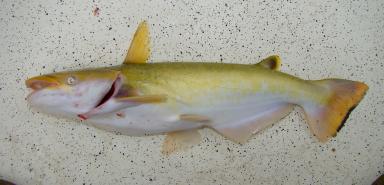
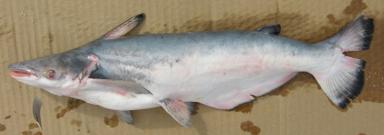
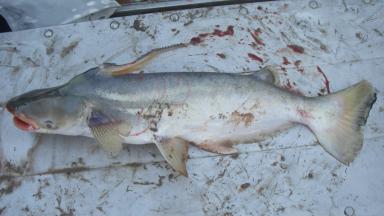 Male, Kurisevo River, Brazil
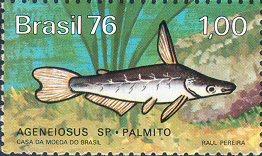 Stamp

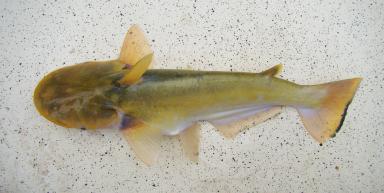
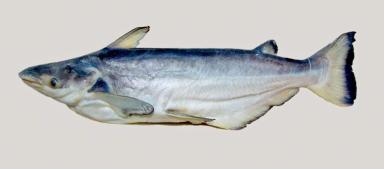
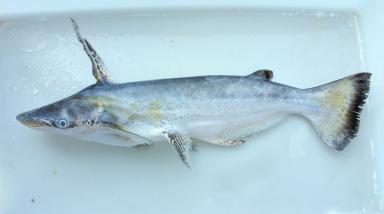

 Close-up of mouth
 Close-up of head
 Juvenile

 Close-up of head


 Juvenile

 Close-up of head

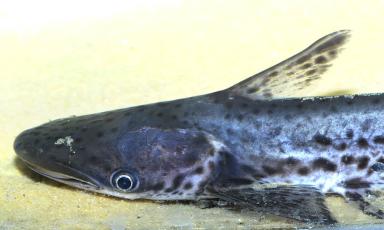

| ⇓ Zebra Pleco (Hypancistrus zebra) Data Sheet | |
|---|---|
| Scientific Name | Ageneiosus inermis (Linnaeus, 1766) |
| Common Names | Slopehead Catfish Bottlenose Catfish, Jaguar Dolphin Catfish, Manduba |
| Type Locality | Suriname. |
| Synonym(s) | Ageneiosus armatus, Ageneiosus axillaris, Ageneiosus barranquenensis, Ageneiosus brevifilis, Ageneiosus dawalla, Ageneiosus gabardinii, Ageneiosus marmoratus, Ageneiosus ogilviei, Ageneiosus sebae, Ageneiosus therezinae, Ageneiosus therezine, Ageniosus axillaris, Ageniosus brevifilis, Davalla schomburgkii, Hypothalmus dawalla, Silurus inermis |
| Pronunciation | ah genie OH sus |
| Etymology | Ageneiosus, from the Greek a, meaning without and genias, meaning beard in reference to the apparent lack of barbels. In fact, catfish of this genus have very short maxillary barbels that are almost indistinguishable to the human eye. There are 2 other speciesNematogenys inermis Pseudobagarius inermis with this name. |
| ⇓ Species Information | |
| Size | 590mm or 23.2" SL. Find near, nearer or same sized spp. |
| Identification | Ageneiosus differs from other Auchenipteridae, except Tympanopleura, by having: 1, long bony process, narrowing distally on anterolateral border of sphenoid; 2, longitudinal groove on posterior margin of anterior fontanel (also present in Pseudepapterus); 3, dorsal portion of posttemporal-supracleithrum divided into two prominent branches; 4, internal and external processes of epioccipital sutured to parapophyses of fifth and sixth vertebrae; 5, bony process on posteromedial border of first infraorbital bone (also present in Tetranematichthys); 6, anterior or posterior region of second infra-orbital very curved; 7, bony expansion on laterodorsal margin of premaxilla; 8, operculum with spongy ossification; 9, bone projections on posterior extreme of the parurohyal; 10, seventh vertebra not fused to complex vertebrae (also present in Pseudepapterus); 11, well-developed crown of spines in proximal region of anterior margin of dorsal-fin spine of mature males; 12, short maxillary barbel, not extending posteriorly beyond snout (also present in Tetranematichthys); 13, mental barbels absent; 14, bony spines on maxillary barbel of mature males; 15, posterior lobes of testes reduced or absent (also present in Auchenipterus). Ageneiosus differs from Tympanopleura by having: 1, reduced and completely ossified gas bladder in adults, except Ageneiosus pardalis Lütken 1874 (v. large, non-ossified gas bladder during all phases of ontogenetic development); 2, posterior diverticula on the gas bladder absent (v. having paired posterior diverticula on the gas bladder, except T. piperata); 3, epaxial muscles almost completely covering the tympanic region in adults, except A. pardalis (v. tympanic region translucent, not covered by epaxial muscles); 4, dorsal process on the base of pectoral fin weakly developed, loosely articulating with cleithrum (v. dorsal process on the base of pectoral fin well developed, strongly articulating with cleithrum); 5, fenestra on the lateral wall of cleithrum (v. lateral wall of cleithrum completely ossified).
A key to the species of Ageneiosus is located here. Body naked and elongated. Head is pointed and depressed at the top. Mouth is big and wide. The lateral eyes are situated along the level of the mouth, ensuring a vision above and below. Exhibits sexual dimorphism, like A. dentatus. The first ray of the dorsal fin is very long and has pointed spines. For individuals longer than about 170 mm SL, uniform colour on sides of body or with a short dark stripe below lateral line, not extending beyond midpoint of trunk. Individuals less than about 150 mm SL are covered with marmorated pattern of large dark blotches on sides; generally a dark band on distal margin of caudal-fin rays. |
| Sexing | Observed in nuptial males. Predorsal profile distinctly more acutely angled upward than in females, juveniles and non-nuptial males. Maxillary barbel entirely ossified, forming a rigid, thickened, elongate barbel that may reach beyond the anterior eye margin when adpressed to the side of the head. Two rows of sharp recurved hooks on dorsal margin of barbel. Articular surface of maxilla expanded for contact with autopalatine. Dorsal-fin spine elongate, rigid, aculeiform, straight to strongly arched. Anterior margin of the dorsal-fin spine with pungent, unicuspid serrae, closely spaced proximally, recurved laterally, forming an enlarged, ossified protuberance at the anterior base of the spine; serrae distally arranged in a row, sometimes absent along middle quarter to third of spine. Dorsal-fin spine of nuptial males may be hyperextended anteriorly to approximately a 45° dorso-anterior angle, instead of the near-vertical limit of females and juveniles. The first branched dorsal-fin ray is much longer than in non-breeding males and females. Unbranched and first few branched anal-fin rays thickened and elongate to form a tubular intromittent organ bound by integument to the anterior margin of the anal fin. Urogenital opening of nuptial male displaced as a simple pore at the distal tip of intromittent organ. |
| ⇓ Habitat Information | |
| Distribution | South America. Amazon (click on these areas to find other species found there) Guyana Waters, Coastal Rivers of Guyanas (click on these areas to find other species found there) La Plata (click on these areas to find other species found there) Amazon, Middle Amazon (Solimoes), Purus, Macapá (click on these areas to find other species found there) Orinoco (click on these areas to find other species found there) Amazon, Lower Amazon, Tocantins, Lower Tocantins, Pará, Anapu Imported (click on these areas to find other species found there) Amazon, Lower Amazon, Xingu, Iriri Imported (click on these areas to find other species found there) Amazon, Middle Amazon (Solimoes), Negro Imported (click on these areas to find other species found there) La Plata, Paraná Imported (click on these areas to find other species found there) Amazon, Middle Amazon (Solimoes), Purus Imported (click on these areas to find other species found there) Amazon, Lower Amazon, Tocantins, Lower Tocantins, Araguaia, Upper Araguaia, Vermelho Imported (click on these areas to find other species found there) Amazon, Lower Amazon, Xingu Imported (click on these areas to find other species found there) Login to view the map. |
| IUCN Red List Category | Not Evaluated , a distribution map is available on the IUCN species page. Last assessed 2026. |
| pH | 6.0 - 7.8 |
| Temperature | 22.0-26.0°C or 71.6-78.8°F (Show species within this range) |
| Other Parameters | dH 20. |
| ⇓ Husbandry Information | |
| Feeding | Feeds on crustaceans and fishes. User data. |
| Breeding | Has been bred in the aquarium. |
| Breeding Reports | There is no breeding report. |
| ⇓ Further Information | |
| Reference | Systema naturae sive regna tria naturae v. 1 (pt 1), pp 503. |
| Wishlists | There is no wish to keep this species. |
| Spotters | There is no record of this fish being seen. |
| ⇓ More Resources | |
| Forum BBCode | |
| Find CLOG | 29 mentions on the forum, starting 6th May 06 |
 | Look up A. inermis on PlanetCatfish.com |
 | Look up A. inermis on Fishbase |
 | Look up A. inermis on Encyclopedia of Life |
 | Look up A. inermis on Global Biodiversity Information Facility |
 | LFS label creator ARN ref:1.22.105.1471 |
| Last Update | Thu Jan 02, 2025 9:40 am (Species record created: Wed Oct 08, 2003 7:00 am) |
