
PAGE_HEADER

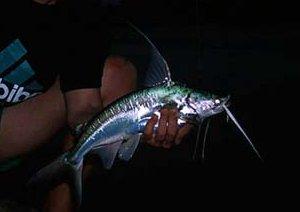
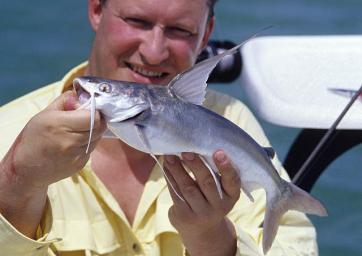 Caught off the coast of Texas
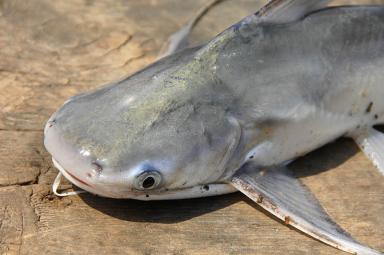
 Close-up of head
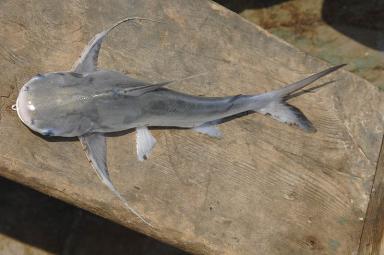
 Dorsal view
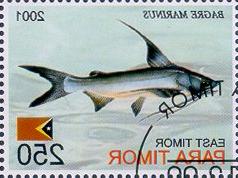
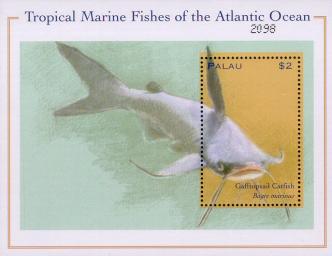 Stamp
 Stamp
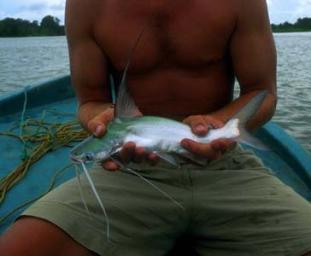 Rio San Juan, near El Castillo, Nicaragua
 Caught off the coast of Costa Rica
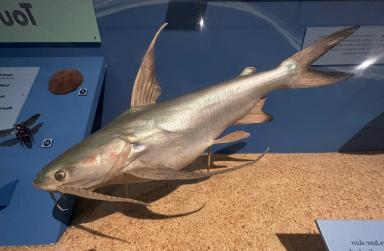
 Taxidermy
| ⇓ Zebra Pleco (Hypancistrus zebra) Data Sheet | |
|---|---|
| Scientific Name | Bagre marinus (Mitchill, 1815) |
| Common Names | Gafftopsail Catfish Bagre Cacumo (Spanish, USA), Topsejlmalle (Danish, Denmark) |
| Type Locality | New York, U.S.A. |
| Synonym(s) | Aelurichthys longispinis, Felichthys felis, Felichthys marinus, Galeichthys bahiensis, Galeichthys blochii, Galeichthys parrae, Silurus marinus |
| Pronunciation | BAG ray - mar in uss |
| Etymology | Bagre: From the Mozarabic bagre, taken from Greek, pagros, meaning fish (of the genus Dentex). Now used in Spanish vernacular to mean catfish. |
| ⇓ Species Information | |
| Size | 690mm or 27.2" SL. Find near, nearer or same sized spp. |
| Identification | Overall grey with a blue sheen. Barbels on upper jaw noticeably flat. Long filaments on pectoral and dorsal fins reaching nearly to or beyond the anal fin. Caudal fin deeply forked with slightly longer upper lobe. Anal fin with concave margin. Bagre marinus is distinguished from congeners by having 22–26 anal fin rays, cephalic shield smooth and (at lateral ethmoid area) width of 15.6–18.0% SL, anal fin base length 15.4–20.3% SL, anterior nuchal plate indistinct from middle and posterior nuchal plates, and dorsal fin band-like filament not reaching anterior insertion of adipose fin; supraoccipital process profile moderately elevated posteriorly; anal and pelvic fins with dark blotch); 7–12 gill rakers on first branchial arch (rarely 22). |
| General Remarks | Where plentiful, they are caught on longlines, bottom trawls, shore seines, cast nets, and hook and line. Not considered a food fish in North America, but eaten throughout the Caribbean and Northern South America where its flesh is considered tasty. |
| ⇓ Habitat Information | |
| Distribution | Western Atlantic: coast of Gulf of Mexico, Cuba, western margin of the Caribbean, and the northern margin of South America. Sometimes in rivers and estuaries. Atlantic, Caribbean Sea (click on these areas to find other species found there) Atlantic, Gulf of Mexico (click on these areas to find other species found there) Atlantic, West Atlantic (click on these areas to find other species found there) Login to view the map. |
| IUCN Red List Category | Least Concern , a distribution map is available on the IUCN species page. Last assessed 2014. |
| pH | 8.0 - 8.4 |
| Temperature | 10.0-20.0°C or 50-68°F (Show species within this range) |
| Other Parameters | This is a true marine fish. |
| ⇓ Husbandry Information | |
| Feeding | An opportunistic feeder in the wild that would be expected to consume a wide range of aquarium fare. User data. |
| Furniture | A marine aquarium containing a sand substrate and live rock to provide hiding places. |
| Compatibility | Other cold to cool water marine fishes that are too large for this fish to eat. |
| Breeding | Unreported. It is known that spawning in the wild occurs from May to June and that the male holds the large fertilised eggs in its mouth for up to two months until they hatch. The male does not eat during the incubation period. |
| Breeding Reports | There is no breeding report. |
| ⇓ Further Information | |
| Reference | Transactions of the Literary and Philosophical Society of New-York v. 1 (art. 5) (for 1814), pp 433. |
| Wishlists | There is no wish to keep this species. |
| Spotters | There is no record of this fish being seen. |
| ⇓ More Resources | |
| Forum BBCode | |
| Find CLOG | 8 mentions on the forum, starting 26th Dec 03 |
 | Look up B. marinus on PlanetCatfish.com |
 | Look up B. marinus on Fishbase |
 | Look up B. marinus on Encyclopedia of Life |
 | Look up B. marinus on Global Biodiversity Information Facility |
 | LFS label creator ARN ref:1.9.63.137 |
| Last Update | Thu Jan 02, 2025 9:37 am (Species record created: Sun Nov 11, 2001 8:00 am) |
