
PAGE_HEADER
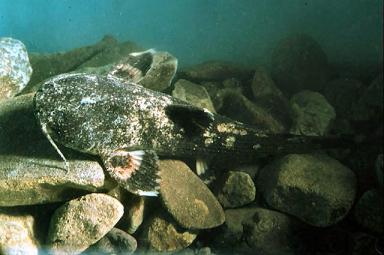
| ⇓ Zebra Pleco (Hypancistrus zebra) Data Sheet | |
|---|---|
| Scientific Name | Acrochordonichthys falcifer Ng & Ng, 2001 |
| Common Name | Asian Banjo Cat |
| Type Locality | Sungai Segama, Sabah, Borneo, Malaysia. |
| Synonym(s) | |
| Pronunciation | ack roe KOR don ick thees - fall siff err |
| Etymology | Acrochordonichthys: From the Greek akrochordon, meaning wart, and
ichthys, meaning fish; in reference to the tuberculate skin. The specific epithet comes from the Latin falx, meaning scythe and fere, meaning to bear; in reference to the curved and smooth pectoral spines. There is 1 other speciesPuntioplites falcifer with this name. |
| ⇓ Species Information | |
| Size | 92mm or 3.6" SL. Find near, nearer or same sized spp. |
| Identification | Catfish of the genus Acrochordonichthys are cryptically coloured species generally found at the bottoms of rivers throughout Southeast Asia. They have a highly rugose skin with tubercles arranged in longitudinal rows along the side of the body, a long low adipose fin and an emarginate caudal fin. Colour pattern with many small spots of various shades of brown; many small, dark brown spots on the dorsal surface of the head. Head length 22.4-28% SL; width 24-28.6%SL; depth 14.5-19.5% SL). Body depth at anus 10.9-13.6% SL; caudal peduncle depth 5.4-6.6% SL. Dorsal to adipose distance 5.5-7.7% SL; snout length 36.8-40.9% HL. Dorsal-fin base 10.8-13.1% SL. Rounded posterior margin of adipose fin. Head with small tubercles with poorly demarcated and indistinct margins; tubercles on body arranged in 5-6 longitudinal rows on each side. Premaxillary tooth band not exposed when the mouth is closed. Pectoral spine without serrations. |
| Sexing | Difficult to sex. Males have a more slender genital papilla immediately in front of anus. Females tend to be larger and fuller-bodied. |
| ⇓ Habitat Information | |
| Distribution | Asia: known only from the Kinatabangan and Segama river drainages, and possibly from the Kayan River drainage in northeastern Borneo, Malaysia. Pacific, Greater Sunda Island Rivers, Borneo Waters, Kinabatangan (click on these areas to find other species found there) Pacific, Greater Sunda Island Rivers, Borneo Waters, East Borneo Waters, Segama (click on these areas to find other species found there) Login to view the map. |
| IUCN Red List Category | Not Evaluated , a distribution map is available on the IUCN species page. Last assessed 2026. |
| pH | 5.8 - 7.2 |
| Temperature | 18.0-25.0°C or 64.4-77°F (Show species within this range) |
| Other Parameters | Requires fairly well-oxygenated water and a strong current is preferred. |
| ⇓ Husbandry Information | |
| Feeding | Ambush predator. Easily adapts to a diet of frozen food and pellets in the aquarium. May eat small bottom dwellers. User data. |
| Furniture | Inhabits clear, swiftly flowing forested streams with sandy or rocky bottoms; hides under submerged logs or rocks with some leaf litter in the swifter parts of the stream. The fish does appear to move about after dark, as it is often found wedged under cover during the day. Driftwood and rocks seem to be their favourite cover, so provide plenty of these. |
| Compatibility | Can be kept with anything other than small bottom dwellers. |
| Breeding | Unreported in the aquarium. |
| Breeding Reports | There is no breeding report. |
| ⇓ Further Information | |
| Reference | Journal of Fish Biology v. 58 (no. 2), pp 408, Figs. 5a, 6g, 16 |
| Wishlists | There is no wish to keep this species. |
| Spotters | There is no record of this fish being seen. |
| ⇓ More Resources | |
| Forum BBCode | |
| Find CLOG | 1 mention on the forum, starting 14th Mar 09 |
 | Look up A. falcifer on PlanetCatfish.com |
 | Look up A. falcifer on Fishbase |
 | Look up A. falcifer on Encyclopedia of Life |
 | Look up A. falcifer on Global Biodiversity Information Facility |
 | LFS label creator ARN ref:1.29.246.1363 |
| Last Update | Thu Jan 02, 2025 9:36 am (Species record created: Wed Oct 27, 2004 7:00 am) |
