
PAGE_HEADER
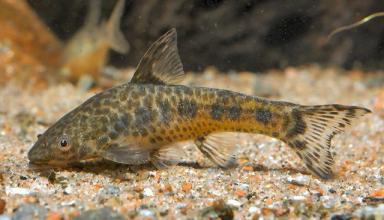 Female
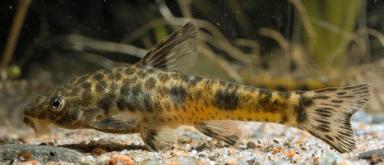 Male
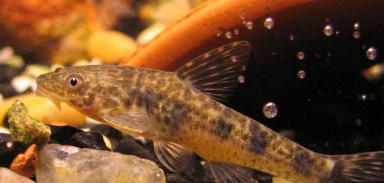
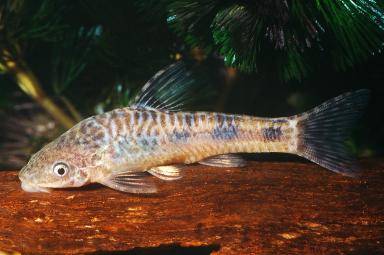
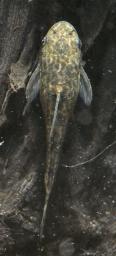 Dorsal view
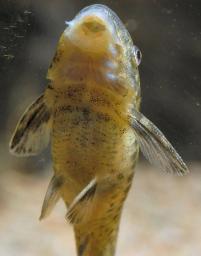 Ventral view
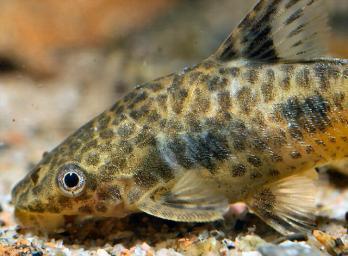 Close-up of upper body
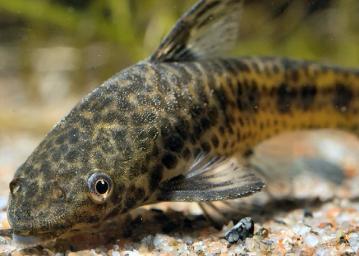 Ventral / head-on view
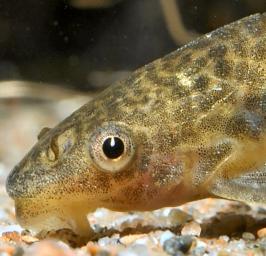 Close-up of head
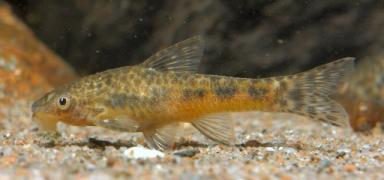 Fright / night colouration
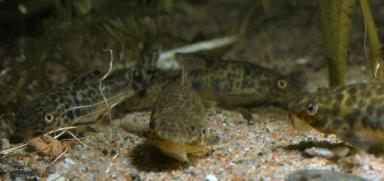 Group
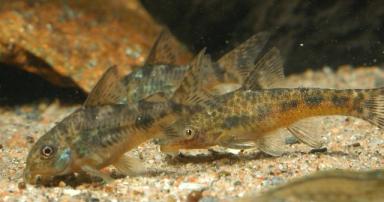 'Mimicking'
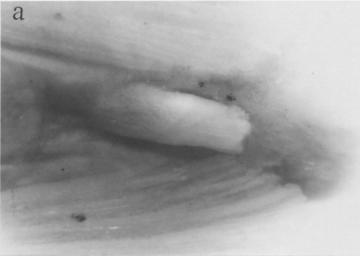 Female, showing anus
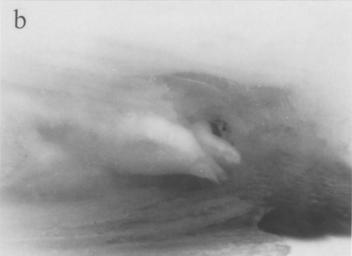 Male, showing anus and urogenital papilla
| ⇓ Zebra Pleco (Hypancistrus zebra) Data Sheet | |
|---|---|
| Scientific Name | Otocinclus flexilis Cope, 1894 |
| Common Names | Peppered Oto Argentinischer Ohrgitter-harnischwels (German, Germany), Grå Dværgsugemalle (Danish, Denmark) |
| Type Locality | Rio Jacuhy [Jacuí], Rio Grande do Sul, Brazil. |
| Synonym(s) | Macrotocinclus flexilis, Otocinclus fimbriatus |
| Pronunciation | auto SINK luss - flex ill iss |
| Etymology | Greek, ous, oto = ear + Latin, cinclus = latticework; in allusion to the holes of the head in the ears. |
| ⇓ Species Information | |
| Size | 55mm or 2.2" SL. Find near, nearer or same sized spp. |
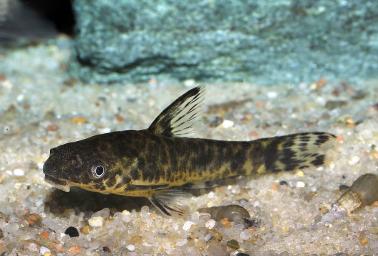
| Identification | An easy species of Otocinclus to identify although two colour forms exist. One with a more pronouced darker and lighter "peppering" and one with a more regular pattern. This variance aside, the colouration is the same as the common peppered Cory, Corydoras paleatus. Coloration of individual otos vary with mood. Normal coloration is beige with spots, but this species (in presumed breeding mode) turn darker, and may become almost black.
Other species of Otocinclus which can have a blotched colour pattern are O. arnoldi, O. mimulus, and O. xakriaba. O. flexilis is distinguished from O. arnoldi and O. mimulus by having six branched pectoral-fin rays (vs. five branched rays in O. arnoldi and O. mimulus). O. flexilis is distinguished from O. xakriaba by the presence of a triangular pigment mark at the dorsal-fin base of O. flexilis (absent on O. xakriaba). |
| Sexing | Females are larger and broader especially when viewed from above. Females are considerably larger than males and fuller in girth. |
| ⇓ Habitat Information | |
| Distribution | South America: Middle and lower Paraná/Paraguay, Uruguay and La Plata basins and Atlantic coastal streams of southeastern Brazil. La Plata (click on these areas to find other species found there) La Plata, Paraná, Lower Paraná (click on these areas to find other species found there) La Plata, Paraná, Middle Paraná (click on these areas to find other species found there) La Plata, Paraná, Paraguay (click on these areas to find other species found there) La Plata, Uruguay (click on these areas to find other species found there) Login to view the map. |
| IUCN Red List Category | Not Evaluated , a distribution map is available on the IUCN species page. Last assessed 2026. |
| pH | 6.5 - 7.8 |
| Temperature | 20.0-25.0°C or 68-77°F (Show species within this range) |
| Other Parameters | 2-25 dGH. |
| ⇓ Husbandry Information | |
| Feeding | New imports can be tricky to acclimatise to prepared foods, but once this hurdle is overcome (using frozen bloodworm and algae wafers) they feed greedily. User data. |
| Furniture | Less reliant on plants than other Otocinclus species, nevertheless, tall leaved plants like Vallisneria provide habitat and shade for these species that also appreciate vertical wood surfaces but generally move around the aquarium without preference. Gravel or sand may be used. |
| Compatibility | A highly social, diurnal and hardy species. Slightly aggressive (more akin to slightly larger loricariids); they defend food albiet half-heartedly, and dominate Corydoras at feeding time but not to the other species detriment. Also when kept with Corydoras paleatus, the Corys appear fooled by the oto mimics, and often follow them around, gulp air at the same time the otos do, and even male corys display to otos. The otos on the other hand seem aware which fish are conspecifics, as they're noticeably more aggressive towards the corys than to each other. Perhaps the bright white opercular diverticulum serves as a recognition signal for the otos? They have a curious behaviour that they nibble at each other and corys at the base of the dorsal fin, something which is apparently very unpleasant for the receiving fish - it looks like aggressive/dominance behaviour. |
| Suggested Tankmates | Keep in groups (preferably at least six) with any small to mid-sized community fish. |
| Breeding | It is reported that smaller male fish 'dance' in front of larger fish, 'nudge' the larger fish in the region of the cloaca, and also follow them around very closely. Actual reproduction is unreported. |
| Breeding Reports | There is no breeding report. |
| ⇓ Further Information | |
| Reference | Proceedings of the American Philosophical Society v. 33, pp 97, Pl. 8 [7] (figs. 13, 13a-b). |
| Wishlists | There is no wish to keep this species. |
| Spotters | There is no record of this fish being seen. |
| ⇓ More Resources | |
| Forum BBCode | |
| Find CLOG | 13 mentions on the forum, starting 8th Jan 05 |
 | Look up O. flexilis on PlanetCatfish.com |
 | Look up O. flexilis on Fishbase |
 | Look up O. flexilis on Encyclopedia of Life |
 | Look up O. flexilis on Global Biodiversity Information Facility |
 | LFS label creator ARN ref:1.4.49.1350 |
| Last Update | Thu Jan 02, 2025 9:38 am (Species record created: Sat Aug 21, 2004 7:00 am) |
