
PAGE_HEADER
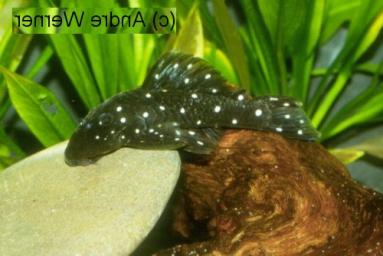
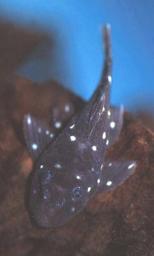 Dorsal View
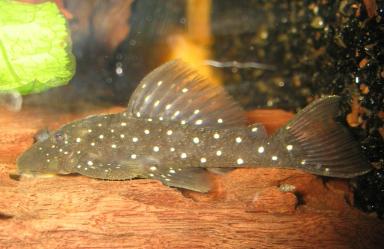
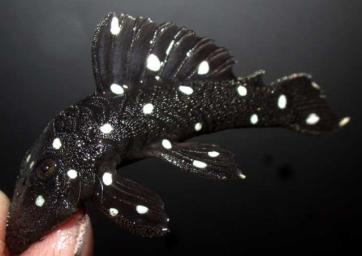
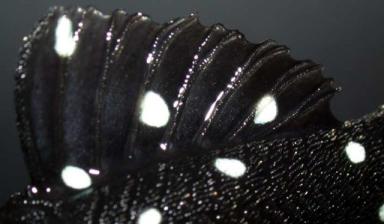
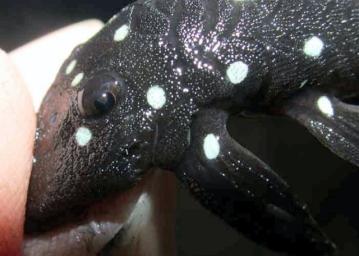
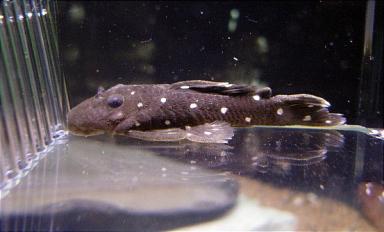
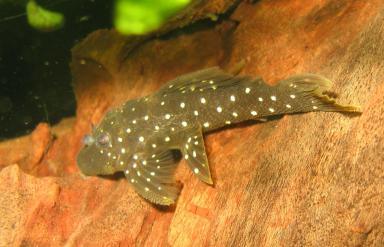
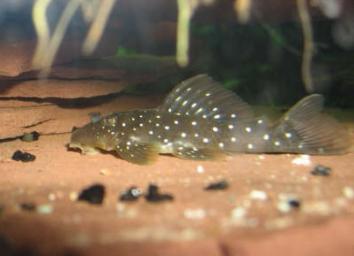
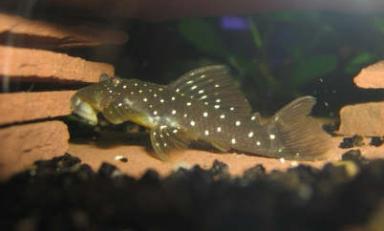
| ⇓ Zebra Pleco (Hypancistrus zebra) Data Sheet | |
|---|---|
| Scientific Name | Spectracanthicus sp. (L254) |
| Common Names | L254, Blådråbet Sugemalle (Danish, Denmark) Blue Drop Pleco |
| Synonym(s) | |
| Etymology | Genus: Latin, spectrum = look, apparition + Greek, akantha = thorn. |
| ⇓ Species Information | |
| Size | 110mm or 4.3" SL. Find near, nearer or same sized spp. |
| Identification | Spectracanthicus can be separated from all other loricariids except some Baryancistrus, Parancistrus and an undescribed Hemiancistrus by the presence of the dorsal-fin membrane contacting the adipose-fin spine. It can be separated from Baryancistrus and the Hemiancistrus by having fewer teeth (less than 25 vs. greater than 25) and from Parancistrus by having restricted gill openings. A key to the genus can be found here. Generally, the main difference between Oligancistrus and Spectracanthicus is the size and form of the dentition and the number of teeth in all sides of the jaws. Spectracanthicus has considerably fewer teeth than Oligancistrus. Also the eye diameter is larger in Oligancistrus. L254 is sometimes identified as being Oligancistrus punctatissimus - according to Steindachner's original description and drawing O. punctatissimus fits almost any Oligancistrus type with black body and white small spots, it's closest to L016 and L353. Comparison of the Oligancistrus holotype and various species available in the aquarium trade, like L016, L020, L031, L086, L254, L315, L353,L354, L363, L373, Spectracanthicus murinus and a few other Oligancistrus species without L-Numbers from Rio Xingu / Iriri and the Rio Jari found none that matched O. punctatissimus. So Steindachner's description is more or less useless without the holotype. Direct comparisons with that holotype suggest O. punctatissimus species has almost certainly never been exported and is only known from the holotype. It certainly isn't L254. |
| Sexing | Males get noticably heavier set, grow long cheek odontodes and have an overall more bristling appearance. |
| ⇓ Habitat Information | |
| Distribution | Brazil, Rio Xingú (about 150 km south of Altamira). Amazon, Lower Amazon, Xingu (click on these areas to find other species found there) Login to view the map. |
| pH | 6.0 - 7.6 |
| Temperature | 26.0-30.0°C or 78.8-86°F (Show species within this range) |
| Other Parameters | A reasonable current is preferred. |
| ⇓ Husbandry Information | |
| Feeding | A smaller carnivore, feed meaty or flake based tablets and pellets, frozen bloodworm or brineshrimp and chopped molluscs. User data. |
| Furniture | The Rio Xingú is full of rocks of many sizes with some fine sand between them. The secretive species should have plenty rocks to scuttle under, bogwood and plants are not required, the latter are however left entirely unmolested. |
| Compatibility | Territorial but not overly so, a good l-number for a general community tank of small to medium size but not a great choice for a group of l-numbers. |
| Suggested Tankmates | Does well with most fish |
| Breeding | Unreported in the aquarium. |
| Breeding Reports | There is no breeding report. |
| ⇓ Further Information | |
| Reference | Introduced in DATZ 1/1998, pp 6-7. |
| Wishlists | There is no wish to keep this species. |
| Spotters | There is no record of this fish being seen. |
| ⇓ More Resources | |
| Forum BBCode | |
| Find CLOG | 10 mentions on the forum, starting 6th Jan 07 |
 | Look up S. sp. (L254) on PlanetCatfish.com |
 | LFS label creator ARN ref:1.4.88.1288 |
| Last Update | Wed Jan 19, 2022 7:21 pm (Species record created: Sun May 30, 2004 7:00 am) |
