
PAGE_HEADER
 Juvenile
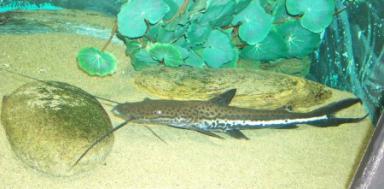 Sub-adult

 Juvenile
 Juvenile - dorsal view
 Juvenile


 Mature fish
 Mature fish in large home
 Video - juvenile
| ⇓ Zebra Pleco (Hypancistrus zebra) Data Sheet | |
|---|---|
| Scientific Name | Sorubimichthys planiceps (Spix & Agassiz, 1829) |
| Common Names | Firewood Catfish Acha Cubo (Spanish, Peru), Cabo De Hacha (Spanish, Colombia), Doncella (Spanish, Venezuela), Guerevere (Guarani, Peru), økseskaftmalle (Danish, Denmark), Paletona (Spanish, Venezuela), Peixe-lenha (Portuguese, Brazil), Spatelwels (German, Germany) |
| Type Locality | Amazon River basin, Solimões, Rio Negro. |
| Synonym(s) | Platystoma planiceps, Platystoma spatula, Pteroglanis manni, Sorubim jandia, Sorubim pirauaca, Sorubimichthys ortoni, Sorubimichthys spatula |
| Pronunciation | saw rue bim ick thees - pla neh seps |
| Etymology | Sorubi is the Brazilian local name for this fish (and several other pimelodids) +(Greek)ichthys=fish. The specific epithet, planiceps meaning flathead. There are 3 other speciesHemibagrus planiceps Lasiancistrus planiceps Notarius planiceps with this name. |
| ⇓ Species Information | |
| Size | 1500mm or 59.1" SL. Find near, nearer or same sized spp. |
| Identification | Body has an overall cylindrical shape. Very flattened head. Large long caudal fin. In large specimens the upper jaw surpasses the lower. Overall coloration and colour pattern varies greatly over the animal's range, but the fish generall has a broad cream stripe reaching from the gill cover to the caudal peduncle. This light coloured stripe may or may not be bordered by darker stripes. |
| Sexing | Unknown. Overall adults sizes for females are reported as larger than those of males. |
| General Remarks | The largest specimen reported from the Amazon was 1.5 metres; Puerto Lopez, Colombia 1.6 metres; Rio Caqueta 97 cm. Considered ''Vulnerable'' to extinction due to overfishing by commercial fisheries. Average adult size captured by commercial fisheries has declined in recent years and now averages under one metre. In Puerto Carreno, on the Rio Orinoco, 5.5 tons of S. planiceps were harvested in 2001. Under Colombian law, specimens under 95 cm may not be retained. This would also make the small specimens imported for the aquarium trade illegal. Sadly, this law is rarely enforced. |
| ⇓ Habitat Information | |
| Distribution | South America: Amazon and Orinoco River basins. Amazon (click on these areas to find other species found there) Amazon, Middle Amazon (Solimoes), Japurá, Caquetá (click on these areas to find other species found there) Orinoco, Upper Orinoco, Guaviare (click on these areas to find other species found there) Orinoco, Upper Orinoco, Guaviare, Upper Guaviare, Guayabero (click on these areas to find other species found there) Orinoco, Middle Orinoco, Meta (click on these areas to find other species found there) Orinoco, Middle Orinoco, Meta, Metica (click on these areas to find other species found there) Orinoco (click on these areas to find other species found there) Amazon, Upper Amazon, Putumayo (click on these areas to find other species found there) Amazon, Middle Amazon (Solimoes), Purus Imported (click on these areas to find other species found there) Login to view the map. |
| IUCN Red List Category | Least Concern , a distribution map is available on the IUCN species page. Last assessed 2020. |
| pH | 6.0 - 7.6 |
| Temperature | 24.0-28.0°C or 75.2-82.4°F (Show species within this range) |
| Other Parameters | Normally found in whitewaters high in suspended sediments. |
| ⇓ Husbandry Information | |
| Feeding | A voracious predator that consumes other fishes. User data. |
| Furniture | With an adult size reaching almost five feet, this fish would require a massive tank. The substrate should be sand with large stones and driftwood providing hiding places. The water current should be strong with a high oxygen content. |
| Compatibility | Other fishes with similar water requirements that are too large to be swallowed whole. |
| Suggested Tankmates | Other large catfishes of the families Pimelodidae or Doradidae. |
| Breeding | Unreported. Juveniles appear during the onset of the rainy season. |
| Breeding Reports | There is no breeding report. |
| ⇓ Further Information | |
| Reference | Selecta genera et species piscium quos in itinere per Brasiliam, pp 25, Pl. 12. |
| Wishlists | There is no wish to keep this species. |
| Spotters | There is no record of this fish being seen. |
| ⇓ More Resources | |
| Forum BBCode | |
| Find CLOG | 6 mentions on the forum, starting 13th Jan 04 |
 | Look up S. planiceps on PlanetCatfish.com |
 | Look up S. planiceps on Fishbase |
 | Look up S. planiceps on Encyclopedia of Life |
 | Look up S. planiceps on Global Biodiversity Information Facility |
 | LFS label creator ARN ref:1.15.54.122 |
| Last Update | Thu Jan 02, 2025 9:37 am (Species record created: Sun Apr 22, 2001 7:00 am) |
