
PAGE_HEADER
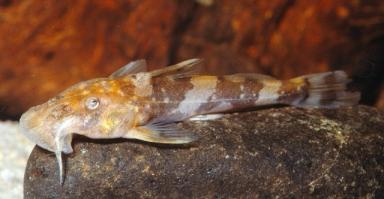
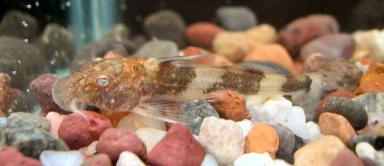
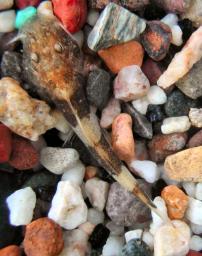 Dorsal view
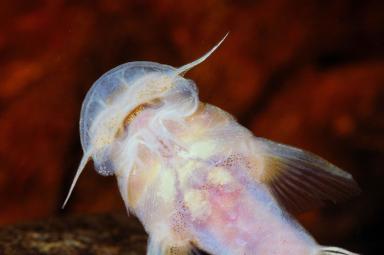 Close-up of mouth
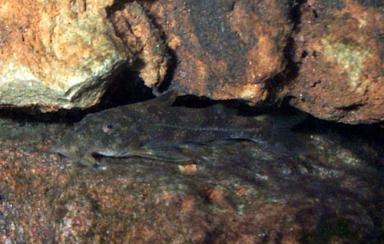
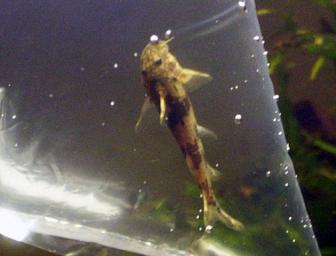
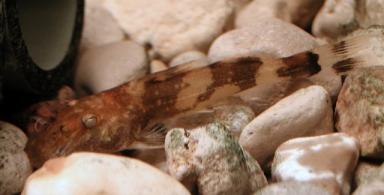
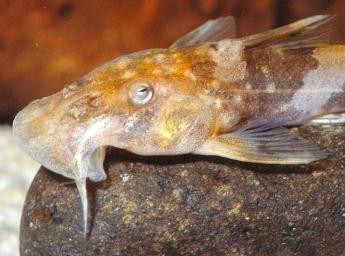 Close-up of head
| ⇓ Zebra Pleco (Hypancistrus zebra) Data Sheet | |
|---|---|
| Scientific Name | Chiloglanis polypogon Roberts, 1989 |
| Common Name | African Suckermouth Catfish |
| Type Locality | High gradient stream along road from Mamfe to Bamenda, 88-94 kilometres southwest of Bamenda, Cross basin, Cameroon, western Africa. |
| Synonym(s) | |
| Pronunciation | Kee low glan iss - paw lee poe gone |
| Etymology | Chiloglanis: From the Greek cheilos, meaning lip, and glanis, meaning catfish; in reference to the oral morphology. The name polypogon (noun in apposition, from the Greek "poly," multiple, and "pogon," beard)refers to the numerous mental barbels. |
| ⇓ Species Information | |
| Size | 55mm or 2.2" SL. Find near, nearer or same sized spp. |
| Identification | The second largest catfish genus in Africa after Synodontis. They are characterized by jaws and lips modified into a sucker or oral disc used for adhering to and feeding upon objects in fast-flowing waters. Generally reasonably small at 100 mm SL or less. species with forked caudal fins can show sexual dimorphism and is usually species-specific. Other characteristics in this hard-to-ID genus are the size of the adipose fin, the position of the adipose fin relative to pelvic and ventral fins, size of barbels, eyes and dorsal fin. Only a handful of species are identified on colouration. They can be distinguished from other African suckermouth catfish (of the genera Euchilichthys and Atopochilus) by their circular suckermouth disc. This is more elliptical in the other two genera. Can be distinguished from South American suckermouth catfishes by lack of body armour plates. Can be distinguised from other African suckermouth catfish (of the genera Euchilichthys and Atopochilus) by its circular suckermouth disc. This is more eliptical in the other two genera. |
| Sexing | Males with an elongate genital papilla. Some other species of Chiloglanis can be easily sexed in the males having enlarged anal and caudal fins of different shapes from the females. |
| ⇓ Habitat Information | |
| Distribution | Africa: Cross River, Cameroon. African Waters, Cross (click on these areas to find other species found there) Login to view the map. |
| IUCN Red List Category | Near Threatened , a distribution map is available on the IUCN species page. Last assessed 2019. |
| pH | 6.4 - 7.0 |
| Temperature | 22.0-26.0°C or 71.6-78.8°F (Show species within this range) |
| Other Parameters | A good current is strongly recommended. |
| ⇓ Husbandry Information | |
| Feeding | Will eat a wide variety of prepared and frozen foods. Supplement with algae wafers. User data. |
| Furniture | Provide plenty of rocks for hiding. Tank does not need to be well-planted. |
| Compatibility | Peaceful both with conspecifics and other fish, and therefore, suitable for the community tank. |
| Suggested Tankmates | Good with many small- to mid-sized community fish. Ideal tankmates include fast-water Synodontis (such as S. brichardi and S. soloni), fast-water African characins and cyprinids like Nannocharax and Garra. |
| Breeding | Not known in aquarium, although other species have been successfully bred in natural enclosures. |
| Breeding Reports | There is no breeding report. |
| ⇓ Further Information | |
| Reference | Proceedings of the California Academy of Sciences (Series 4) v. 46 (no. 6), pp 168, Figs. 1b, 2b, 3c-d, 6a-b, 8. |
| Wishlists | There is no wish to keep this species. |
| Spotters | There is no record of this fish being seen. |
| ⇓ More Resources | |
| Forum BBCode | |
| Find CLOG | 4 mentions on the forum, starting 25th Apr 05 |
 | Look up C. polypogon on PlanetCatfish.com |
 | Look up C. polypogon on Fishbase |
 | Look up C. polypogon on Encyclopedia of Life |
 | Look up C. polypogon on Global Biodiversity Information Facility |
 | LFS label creator ARN ref:1.13.145.1058 |
| Last Update | Thu Jan 02, 2025 9:36 am (Species record created: Thu Aug 14, 2003 7:00 am) |
