
PAGE_HEADER
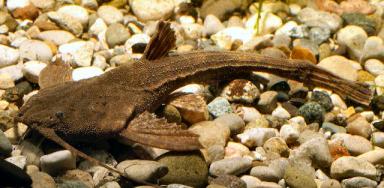
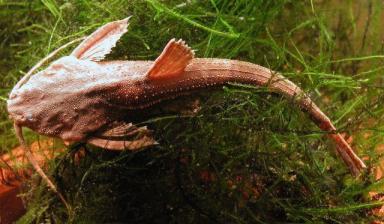
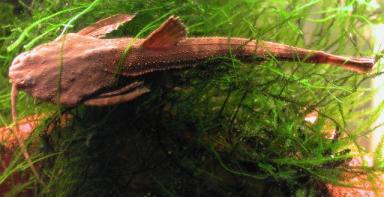
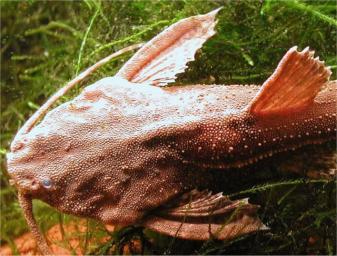
| ⇓ Zebra Pleco (Hypancistrus zebra) Data Sheet | |
|---|---|
| Scientific Name | Pseudobunocephalus amazonicus (Mees, 1989) |
| Common Name | |
| Type Locality | Creek near Todos Santos, upper course of Río Mamoré, Cochabamba, Bolivia. |
| Synonym(s) | Bunocephalus amazonicus, Dysichthys amazonicus |
| Pronunciation | sue doh boon oh SEFF ah luss. - ah mah zohn ick uss |
| Etymology | The generic name is a combination of the Greek word pseudes, meaning false or deceptive, plus the aspredinid genus Bunocephalus. It alludes to the fact that members of this genus have previously been mistaken for juveniles of various species of Bunocephalus. There is 1 other speciesItuglanis amazonicus with this name. |
| ⇓ Species Information | |
| Size | 45mm or 1.8" SL. Find near, nearer or same sized spp. |
| Identification | Relatively small (less than 80 mm SL) banjo catfishes distinguished from other aspredinids by having the following unique characters: the dentary teeth are restricted to broad tooth patch near symphysis of lower jaw (vs. more broadly distributed along the length of the dentary); the metapterygoid lacks a bony connection with the quadrate; the posterior end of autopalatine is distinctly forked and bears two separate terminal cartilages; the absence of the fourth pharyngobranchial; the absence of gill rakers on all branchial arches; and the lack of bifid hemal spines on vertebrae that articulate with anal-fin pterygiophores. Other characters not unique to this genus, but still useful for distinguishing it from other aspredinid genera include: the anterior limits of upper and lower jaws are approximately equal (also in Acanthobunocephalus); the lateral line is truncated at approximately the level of the dorsal-fin origin (also in Acanthobunocephalus); the dorsal- and ventral-most principal caudal rays much shorter in length than other principal caudal rays (also in Acanthobunocephalus); the dorsal- and anal-fin membranes are not adnate with body (also in Acanthobunocephalus); the interhyal is absent (also in Hoplomyzon); and the abdominal and precaudal centra lack bony horizontal lamina (also in Dupouyichthys, Ernstichthys, Hoplomyzon and Micromyzon). |
| ⇓ Habitat Information | |
| Distribution | South America: upper and middle Amazon River basin. Amazon, Middle Amazon (Solimoes), Madeira, Mamoré (click on these areas to find other species found there) Amazon, Middle Amazon (Solimoes) (click on these areas to find other species found there) Amazon, Upper Amazon (click on these areas to find other species found there) Login to view the map. |
| IUCN Red List Category | Least Concern , a distribution map is available on the IUCN species page. Last assessed 2020. |
| ⇓ Husbandry Information | |
| Compatibility | Peaceful. |
| Suggested Tankmates | Can be kept singly or in groups given adequate refuge for each individual. Young fish like to hide vertically in bushy plants. Older fish will burrow in sand or fine, rounded gravel as well as under stones or bogwood. |
| Breeding | Unreported in the aquarium. |
| Breeding Reports | There is no breeding report. |
| ⇓ Further Information | |
| Reference | Proceedings of the Koninklijke Nederlandse Akademie van Wetenschappen (Series C, Biological and Medical Sciences) v. 92 (no. 2), pp 241, Fig. 21. |
| Wishlists | There is no wish to keep this species. |
| Spotters | There is no record of this fish being seen. |
| ⇓ More Resources | |
| Forum BBCode | |
| Find CLOG | 11 mentions on the forum, starting 13th Jan 09 |
 | Look up P. amazonicus on PlanetCatfish.com |
 | Look up P. amazonicus on Fishbase |
 | Look up P. amazonicus on Encyclopedia of Life |
 | Look up P. amazonicus on Global Biodiversity Information Facility |
 | LFS label creator ARN ref:1.10.384.1057 |
| Last Update | Thu Jan 02, 2025 9:40 am (Species record created: Sat Jun 28, 2003 7:00 am) |
